

You are standing in front of the mirror in early May and something feels off.
Maybe your skin looks duller than it did a month ago. Maybe pigmentation that seemed to be fading is suddenly more noticeable. Maybe the products that worked all winter feel like they are not doing enough anymore.
Most women assume they need a completely new routine at this point.
Usually, they do not. What changes first is UV exposure — and your SPF routine for spring and summer needs to keep up.
Why Does UV Exposure Increase So Much in Spring and Summer?
The short answer: the sun sits higher in the sky for longer parts of the day, which means your skin absorbs more ultraviolet radiation during completely ordinary activities — driving, walking to the car, sitting near a window, running errands.
UVA and UVB rays affect skin differently. UVB causes visible burning. UVA rays penetrate deeper and are responsible for collagen breakdown, pigmentation changes, and the gradual visible signs of skin aging. UVA exposure happens year-round and passes through clouds and windows — which is why broad-spectrum SPF matters even on overcast days.
The important part is that UV damage is cumulative. It is not beach days and vacations that cause the most long-term change. It is the repeated, low-level daily exposure that quietly adds up to:
- Collagen breakdown and loss of firmness
- Uneven pigmentation and dark spots
- Dullness and rougher texture
- Fine lines and loss of elasticity
Many visible signs of skin aging are connected more closely to daily UV exposure than to age alone.
Why Does This Hit Harder After 40?
For women in their 40s and beyond, UV exposure in spring and summer carries an extra layer of significance that does not get talked about enough.
As estrogen levels shift during perimenopause and beyond, the skin's natural collagen production slows. Estrogen plays a direct role in how efficiently skin produces and maintains collagen — so when levels decline, skin becomes more vulnerable to the collagen-depleting effects of UV exposure.
This is why the same sun habits that felt fine in your 30s can result in more noticeable changes in your 40s. The skin is not failing. It is working harder with fewer resources.
That makes consistent daily protection — not just occasional sunscreen — one of the most effective things you can do for your skin during this season and this life stage.
Why Does Skin Often Feel More Reactive During Seasonal Changes?
Many women notice that skin becomes more inconsistent in late spring and early summer — sometimes more dehydrated, sometimes more flushed, sometimes just harder to manage.
This is not a sign that something has gone wrong. It usually means the skin barrier is under more environmental pressure than it was in cooler months: longer daylight hours, more UV exposure, heat, air conditioning, and changes in humidity all affect how skin behaves day to day.
Your skin may not need harsher products or an overhaul. It most likely needs more consistent daily protection combined with the right morning support.
Why Does Vitamin C Work So Well Beneath SPF?
Vitamin C is an antioxidant. Antioxidants neutralize free radicals — unstable molecules generated when UV radiation and environmental stress interact with skin. Free radicals contribute to visible collagen breakdown and pigmentation changes over time.
SPF blocks UV radiation at the surface. Antioxidants support skin against the oxidative stress that still occurs throughout the day, even when SPF is applied correctly.
This is why dermatologists and pharmacists often recommend using both together — not choosing one over the other.
Layering an antioxidant serum beneath SPF every morning creates a more complete layer of daily defence:
- SPF reduces UV radiation reaching skin
- Vitamin C helps neutralize free radical activity
- Antioxidants support brighter, more even-looking tone over time
- The combination helps slow the cumulative effects of daily UV exposure
The two work differently and complement each other. Neither replaces the other.
Does Using a Retinoid Mean You Have to Stop in Summer?
This is one of the most common skincare myths — and it leads many women to stop a routine that is actually working.
Retinoids do increase skin cell turnover, which can make skin more sensitive to UV exposure. But that does not mean retinoids are harmful in summer. It means SPF becomes non-negotiable.
Advanced+ Renewal uses retinaldehyde — a form of vitamin A that requires just one conversion step to become active in skin, compared to several steps for standard retinol. That makes it more efficient and, for many people, gentler than traditional retinol while still delivering meaningful results for collagen support and skin renewal.
As a pharmacist-founded brand, our approach to formulation is about effectiveness without unnecessary irritation — which is why retinaldehyde is part of our clean formulation, free from parabens, silicones, and synthetic fragrances.
Used consistently at night with broad-spectrum SPF every morning, a retinoid remains one of the most evidence-backed tools for supporting skin health — in any season.
What Actually Helps Skin During Spring and Summer?
Many women feel like spring and summer require a complicated, overhauled routine.
Usually, consistency matters more than complexity. Here is what actually supports skin most during warmer months:
- Daily broad-spectrum SPF — every morning, rain or shine, indoors or out
- Antioxidant serum beneath SPF — vitamin C applied before sunscreen each morning
- Retinoid at night — consistent use with SPF in the morning
- Gentle cleansing — to remove UV filters, oxidized products, and environmental residue
- Consistent hydration — heat and air conditioning both deplete moisture
- SPF reapplication — when spending 2+ hours outdoors
The goal is not a perfect routine. It is a consistent one that reduces cumulative stress on skin over time.
Where Does Glow Getter 3 Fit In?
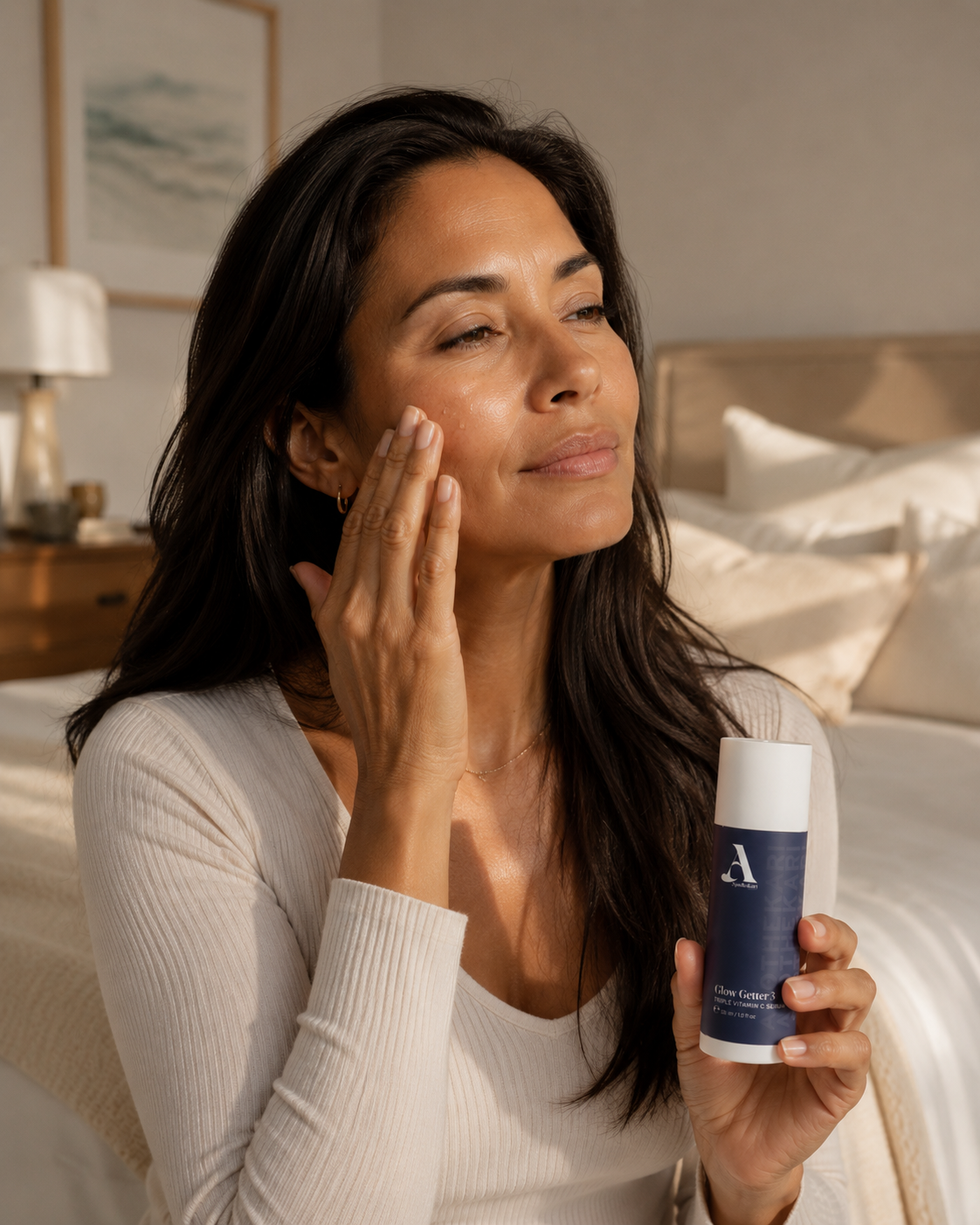
Glow Getter 3 was formulated to solve a specific challenge: the instability of vitamin C in skincare.
Most vitamin C serums rely on a single form of vitamin C — usually L-ascorbic acid — which is potent but unstable and can oxidize before it reaches skin effectively. Glow Getter 3 uses three complementary forms of vitamin C (L-ascorbic acid, Magnesium Ascorbyl Phosphate, and Tetrahexyldecyl Ascorbate) that work at different skin layers and offer better shelf stability.
That makes it especially well-suited as a morning antioxidant during seasons when UV exposure is higher.
For women already using Advanced+ Renewal at night, Glow Getter 3 in the morning paired with daily SPF creates a straightforward AM/PM pairing designed for real, cumulative results. Both are available together in the Radiant Skin Set.
This is not about a complicated routine. It is about giving skin the right support at the right time of day.
Frequently Asked Questions
Should I stop using retinoids in summer? No — stopping retinoids in summer is usually unnecessary and interrupts results you have worked to build. Retinoids increase skin cell turnover, which means consistent SPF becomes more important, not optional. Apply your retinoid at night and broad-spectrum sunscreen every morning, and you can continue using retinoids year-round without issue.
Does vitamin C replace sunscreen? No. Vitamin C is an antioxidant that helps neutralize free radicals and oxidative stress. SPF physically reduces UV radiation reaching the skin. They do different jobs and work best together. Vitamin C applied beneath SPF every morning gives skin two layers of daily defence against UV-related collagen breakdown and pigmentation.
How often should I reapply SPF in summer? For daily incidental exposure — commuting, errands, desk work near windows — one morning application is generally sufficient. If you are spending two or more hours outdoors, reapplication every two hours is recommended. For most women, consistent daily application matters more than perfect reapplication timing.
Why does skin look more dull in spring? Dullness in spring is often caused by a combination of increased UV exposure, seasonal changes in humidity, and accumulated dead skin cells from winter. UV exposure also accelerates the oxidative stress that makes skin appear flat and uneven. Consistent antioxidant support in the morning and regular gentle exfoliation help skin look brighter as the seasons shift.
Why does UV damage happen faster for women in their 40s? Estrogen plays a direct role in collagen production. As estrogen levels shift during perimenopause and beyond, collagen production slows — making skin more vulnerable to the collagen-depleting effects of UV exposure. The same level of UV exposure that felt manageable in your 30s can have more visible effects in your 40s, which is why consistent daily SPF becomes even more valuable at this stage.
What To Do This Week
Look at your current morning routine and ask one simple question: are you protecting your skin as consistently as you are treating it?
If SPF has become occasional instead of daily, this is the week to rebuild that habit. Start with antioxidant support beneath SPF every morning, keep your retinoid at night, and focus on consistency rather than perfection.
If your skin feels different every time the seasons change, your protection routine may need to change with it.
Explore Glow Getter 3 and see why antioxidant support beneath SPF becomes even more important as UV exposure increases through spring and summer.
Already using Advanced+ Renewal at night? The Radiant Skin Set pairs both serums together — morning antioxidant support and night renewal in one straightforward routine.


