

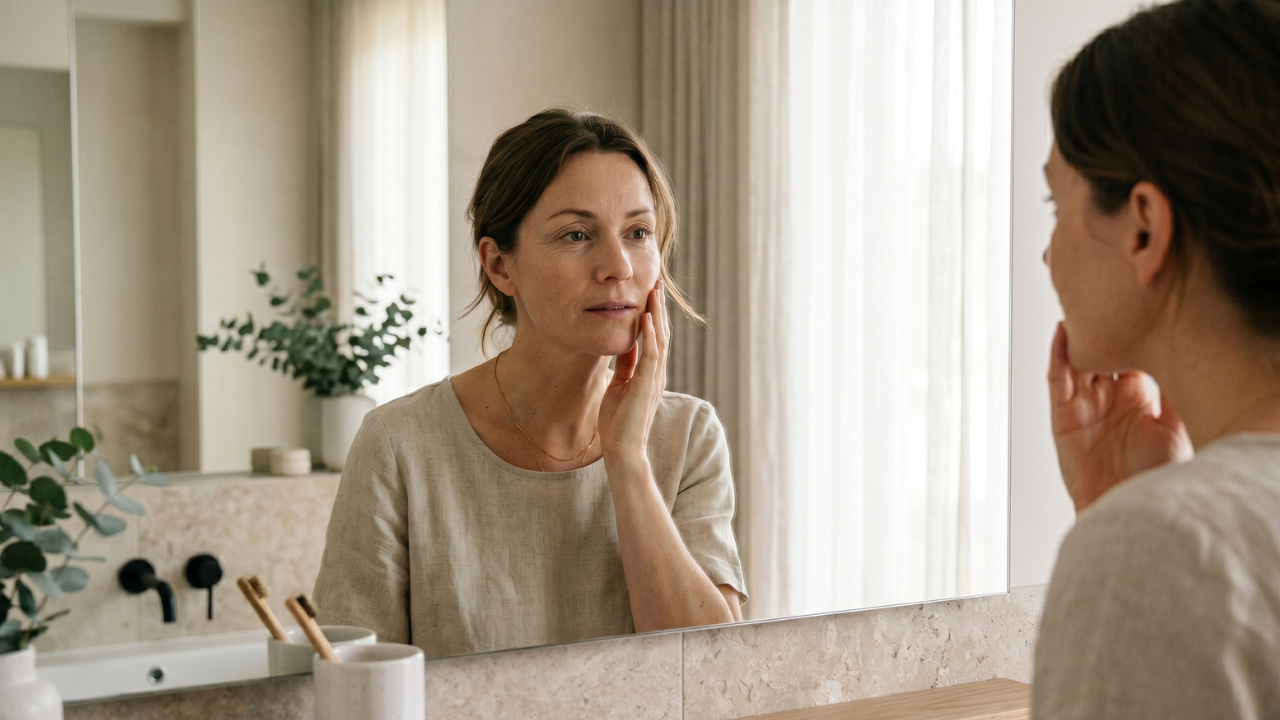
You didn’t imagine it. And you didn’t do anything wrong.
A lot of women describe the same experience: skin that felt manageable — even good — through their late 30s. Then somewhere around 40, 41, 42, something shifted. Products stopped working the way they used to. Skin that was never particularly dry suddenly felt tight. New sensitivity appeared. The face in the mirror started looking a little different in ways that were hard to name.
It’s one of the most common things we hear from women in their 40s — and it’s one of the least well explained. So here’s what’s actually happening.
What Actually Happens in Your Early 40s
The early 40s are often when the cumulative effects of hormonal change become visible on the skin for the first time. This isn’t a sudden event — it’s a tipping point that’s been building quietly for years.
Oestrogen levels begin to fluctuate more noticeably during perimenopause — a phase that can start as early as the late 30s for some women. And oestrogen does far more for your skin than most people realise. It supports collagen production, which keeps skin firm and structured. It helps maintain the skin’s natural moisture levels by supporting the production of hyaluronic acid. It regulates oil production through the sebaceous glands. And it keeps the skin barrier — the outermost protective layer — strong, resilient, and able to do its job effectively.
As estrogen shifts, all of those functions shift with it. Not dramatically, not all at once — but gradually, in ways that compound over time until the cumulative effect becomes impossible to ignore.
Why It Feels Like It Happened Overnight
It didn’t — but the tipping point did.
For months or even years before the visible change, your skin was quietly adapting. Collagen production was slowing. The barrier was becoming slightly less stable. Cell turnover was taking longer. Oil production was shifting. Each of these changes was subtle on its own.
What happens in the early 40s is that all of these gradual shifts reach a threshold at roughly the same time — and suddenly, the skin’s ability to compensate runs out. Products that used to absorb easily start sitting differently on the surface. Skin that used to recover quickly from a late night or a stressful week takes longer. The morning routine that felt sufficient in September starts feeling like not quite enough by November.
That’s not a failure. That’s biology doing exactly what biology does. The change was always coming. The early 40s are just when it becomes impossible to pretend otherwise.
The Specific Changes and What They Mean
Understanding exactly what’s shifting makes it much easier to respond appropriately. Here’s what estrogen decline actually does to the skin:
- Collagen production slows — skin loses some of its firmness and structure, and fine lines become more visible
- Moisture retention decreases — the skin holds onto water less effectively, leading to dryness and tightness that wasn’t there before
- Cell turnover slows — dead skin cells linger longer on the surface, contributing to dullness and uneven texture
- The skin barrier becomes less stable — it’s more permeable, which means it loses moisture more quickly and lets irritants in more easily
- Oil production shifts — some women experience dryness where they were previously oily; others notice new breakouts from hormonal fluctuation
- Wound healing slows — skin that used to bounce back from blemishes or irritation now takes longer to recover
None of these changes happen in isolation. They happen at the same time, which is why the overall experience can feel so disorienting.
Why Your Old Routine Stops Working
The products in your routine haven’t changed. Your skin has. And that distinction matters more than most people realize.
A moisturizer formulated for the skin you had at 35 may not be providing enough support for the skin you have at 42. A cleanser that felt balanced and gentle when your barrier was stronger may now feel stripping. Actives that your skin processed without issue may now cause sensitivity, because the barrier is less equipped to manage them.
This is why so many women in their 40s describe the frustrating experience of their routine “stopping working” — when in reality, the routine hasn’t changed but the skin underneath it has. The solution isn’t necessarily to add more. It’s to reassess whether what you’re using is still matched to what your skin currently needs.
What This Means Going Forward
The good news is that once you understand what’s driving the change, it becomes much easier to know how to respond. Skin in its 40s isn’t damaged or failing — it has a different set of needs than it did in its 30s, and those needs are well understood.
The focus shifts toward supporting what the skin can no longer do as efficiently on its own: maintaining moisture, supporting barrier function, encouraging cell renewal, and protecting against the environmental damage that accumulates more visibly now that the skin’s natural defenses are less robust.
That’s not a complicated problem. It’s a solvable one — with the right information and the right approach.


