

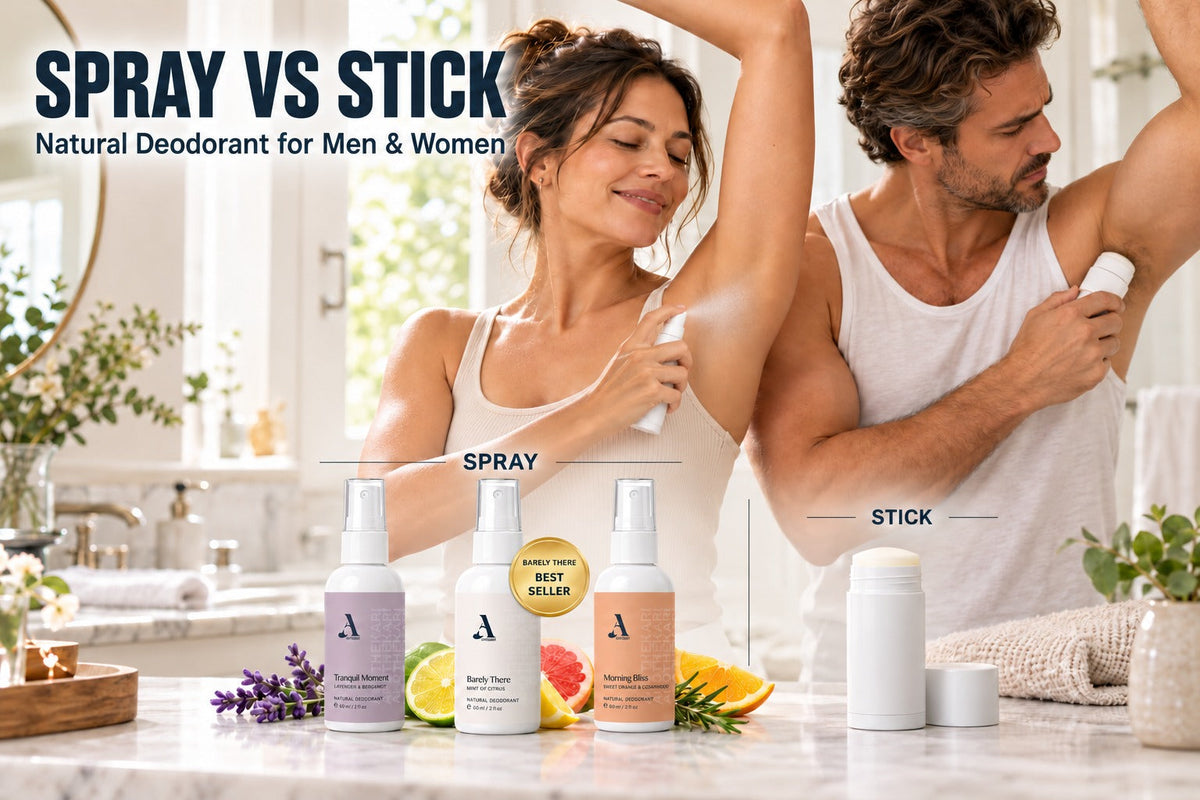
Red Underarms. White Streaks. A Stick That Drags.
If that's been your experience with natural deodorant, you're not alone. Plenty of men and women try going natural, get a rash or a ruined black shirt, and go straight back to their old antiperspirant.
Here's the short answer: the problem usually isn't natural deodorant itself. It's the format and the baking soda. Most natural sticks rely on baking soda, waxes and powders. A baking-soda-free spray skips all three. It goes on clear, dries fast and treats your skin gently. Natural deodorant doesn't have to be a stick.
What's the Difference Between Spray and Stick Deodorant?
Both formats can control odor. The difference is in how they're made and how they feel on your skin.
- What fights odor: Natural sticks usually rely on baking soda. Apothekari's spray uses glycolic acid, saccharomyces ferment and ethylhexylglycerin instead.
- What it's made of: Sticks are built on waxes, oils and powders. A spray is a light liquid that dries quickly.
- What it leaves on clothes: Sticks often leave white marks or oily stains. A spray goes on clear.
- How it feels on your skin: A stick drags across delicate underarm skin. A spray involves no rubbing or friction.
- Sharing: A stick touches your skin directly. A spray is touch-free and easy to share.
- Midday touch-ups: Re-swiping a stick over existing product gets messy. A spray is a quick refresh, even over straps.
Why Does Baking Soda Deodorant Cause a Rash?
Baking soda (sodium bicarbonate) is a popular odor fighter because it's cheap and it does neutralize smell. But it's strongly alkaline, with a pH of around 8 to 9, while healthy skin is slightly acidic, at around 4.5 to 5.5.
When you apply something that alkaline to thin underarm skin every day, it can disrupt your skin barrier. That's when the redness, itching, burning and sometimes darkened patches show up. These symptoms often take a few weeks to appear, which is why many people blame the "detox period" instead of the ingredient.
Is a Natural Deodorant Spray Better for Sensitive Skin?
For most people with sensitive underarms, yes. A spray avoids friction entirely, so it won't drag across delicate underarm skin. And when the formula is baking-soda-free, you remove the most common cause of natural deodorant rashes.
Apothekari's sprays were developed with sensitive skin in mind. Instead of baking soda, the formula uses a triple odor-fighting system:
- Glycolic acid gently lowers underarm pH, making skin less welcoming to odor-causing bacteria.
- Saccharomyces ferment helps neutralize odor as it forms.
- Ethylhexylglycerin conditions skin and helps keep odor-causing bacteria in check.
The formula is also free from aluminum, baking soda, synthetic fragrance, parabens, phthalates, SLS/SLES and synthetic colourants, and it's never tested on animals.
Three Essential-Oil Scents for Every Body
One of the best things about a spray? It's easy to share. Keep one on the bathroom counter for the whole household. Each scent is gender-neutral and comes from essential oils, not synthetic fragrance.
- Barely There: a hint of citrus bergamot. Clean and quiet, and great if you wear cologne or perfume.
- Tranquil Moment: zen lavender. Soft and calming for workdays or evenings.
- Morning Bliss: sweet orange and rosemary. Bright and energizing for mornings and workouts.
How Do You Switch From a Stick to a Spray?
- Start with clean skin. Wash your underarms with a gentle cleanser to remove leftover wax or baking soda.
- Dry completely. Moisture dilutes any deodorant, so pat dry before you apply.
- Spray from about 15 cm (6 inches) away. Two or three sprays per underarm is plenty.
- Let it dry for a few seconds before getting dressed.
- Reapply as needed. After the gym, a long day or a stressful meeting, a quick spray refreshes you.
- Give it a week. Your skin may need a few days to settle into a new pH balance, especially if you're coming off antiperspirant.
FAQ
Is spray or stick deodorant better?
Neither format is automatically better, but sprays have clear advantages for many people. They go on clear without white marks, dry quickly and avoid friction on delicate underarm skin. They're also touch-free, so they're easy to share. The bigger factor is the formula: a baking-soda-free spray is gentler on sensitive skin.
Can men and women use the same natural deodorant?
Yes. Odor forms the same way for everyone: bacteria break down proteins and fats in sweat. The difference between "men's" and "women's" deodorants is mostly scent and packaging. A gender-neutral natural deodorant with essential-oil scents works for anyone and can be shared by the whole household.
Why does my natural deodorant give me a rash?
The most common cause is baking soda. It's highly alkaline, while healthy skin is slightly acidic, so daily use can disrupt the skin barrier and cause redness, itching or burning. Switching to a baking-soda-free natural deodorant usually solves the problem. If irritation continues, check with a pharmacist or doctor.
Does natural deodorant spray stop sweat?
No. Natural deodorant controls odor, not sweat. Only antiperspirants, which use aluminum to block sweat ducts, reduce sweating. A natural deodorant spray lets your body sweat normally while targeting the bacteria that cause odor. Most people find they feel fresh all day once their skin adjusts.
Your Spray Routine Starts Here
Natural deodorant doesn't have to be a stick, and it doesn't have to leave you itchy or streaked. If you're ready for an easier routine, meet the pH Balance Deodorant Set. Try the whole collection and find the scent that's yours, or pick up a single spray to start.
Related reading: The Science Behind pH-Balancing Deodorant and Natural Deodorant for Men That Won't Smell Like Cologne.


