

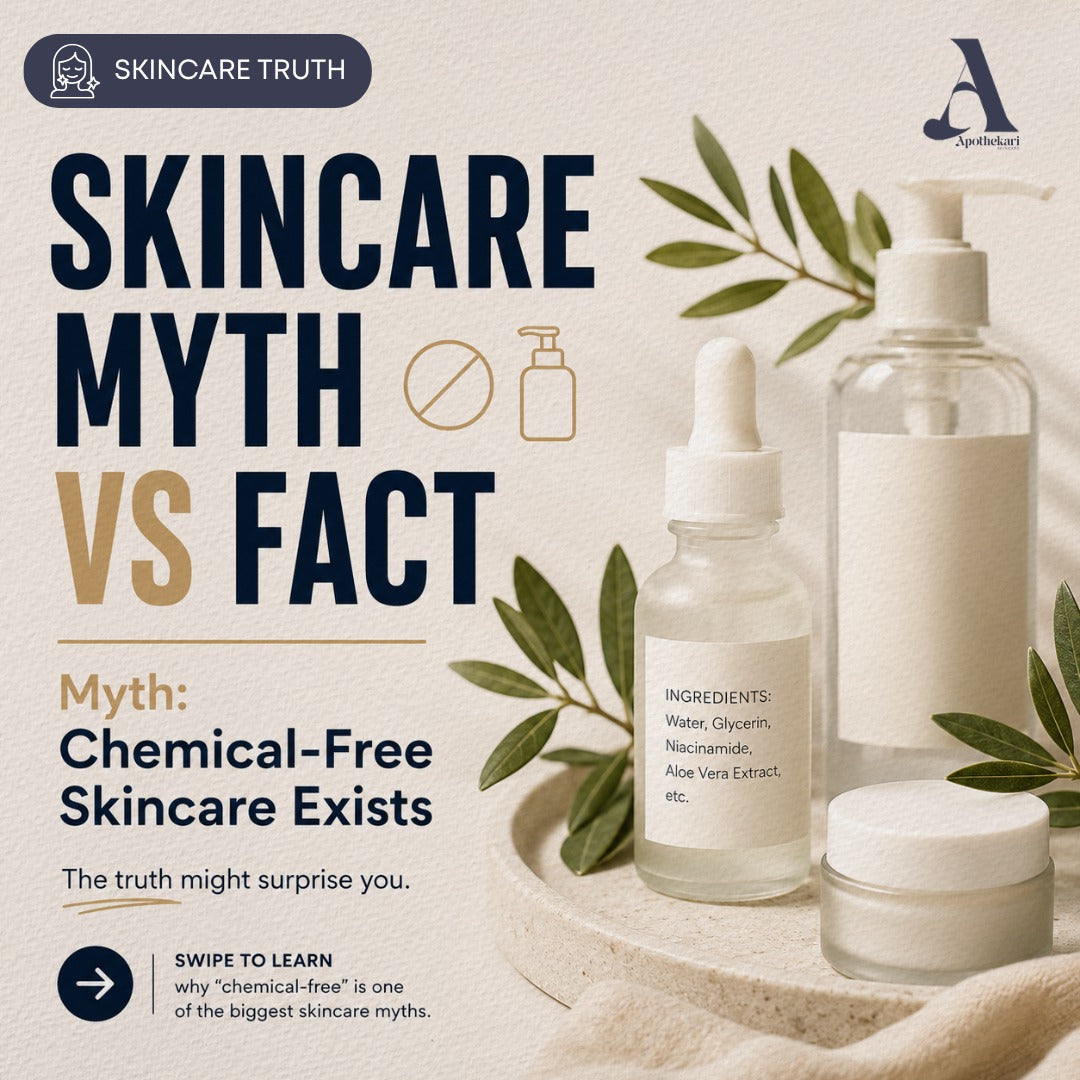
If you've been searching for "chemical-free" skincare, here's the short answer: it doesn't exist. Water is a chemical. Plant extracts are chemicals. Every serum, cleanser, and moisturizer on your shelf — yours included — is made entirely of chemicals. The real question isn't whether a product contains chemicals, it's whether those chemicals are safe, well-formulated, and backed by evidence.
Why Do We Think "Chemical" Means "Bad"?
Marketing has trained us to treat "chemical" as a red flag and "natural" as a green light. It's an easy story to sell, but it isn't accurate. Chemistry is simply the study of matter — and everything around you, from the aloe vera in your moisturizer to the oxygen you breathe, is made of chemicals.
Niacinamide, glycerin, panthenol, and hyaluronic acid are chemicals. So are botanical extracts pulled straight from a plant. Labeling a product "chemical-free" doesn't make it safer; it just makes it vaguer. What actually determines whether an ingredient belongs on your skin isn't its origin story — it's how it was tested, at what concentration, and in what formulation.
What Should You Actually Look For Instead?
The reason "chemical-free" claims are misleading is that they distract from the things that genuinely predict how a product will perform on your skin:
- Ingredient safety — is it proven safe for topical use, at the concentration used?
- Proper formulation — are the ingredients balanced to work together, not against each other?
- Effective concentrations — is there enough of the active ingredient to deliver results without irritation?
- Scientific testing — has the formula been studied, not just marketed?
This is especially important for women navigating hormonal skin changes in their 40s and beyond, when skin becomes more reactive and less forgiving of guesswork. A gentle-sounding "natural" label means very little if the formulation underneath hasn't been tested for irritation or efficacy on changing skin.
Does This Mean All Products Are Equally Safe?
No — and this is where formulation quality matters more than ever. The goal was never to avoid chemicals altogether; it's to choose products made with ingredients that are safe, effective, and well-researched, in the right balance, from a brand that can explain why each ingredient is there. That's a very different standard than "does the label say chemical-free."
This is the philosophy behind every Apothekari formula. Founded by a pharmacist in 2013, Apothekari builds products with transparent ingredient lists and clinically informed concentrations — free from aluminum, parabens, phthalates, formaldehyde, synthetic colourants, synthetic fragrances, and SLS/SLES, and never tested on animals. Not because "chemical-free" is the goal, but because ingredient integrity is.
FAQ: Chemical-Free Skincare
Is chemical-free skincare actually safer? No. Every skincare product, natural or synthetic, is made of chemicals — including water and plant extracts. Safety comes from proper formulation, tested concentrations, and ingredient quality, not from the presence or absence of the word "chemical" on a label.
What does "chemical-free" really mean on a product label? It's a marketing term with no regulated definition. It's often used to imply a product is gentler or more natural, but since all matter is chemical, the phrase is scientifically inaccurate and shouldn't be used to judge a product's safety.
How can I tell if a skincare product is actually safe and effective? Look for clinically tested formulas, transparent ingredient lists, effective (not just trace) concentrations of active ingredients, and a brand that explains the science behind its formulations rather than relying on buzzwords like "natural" or "chemical-free."
Are natural ingredients better than synthetic ones? Not inherently. Origin doesn't determine safety or performance — testing and formulation do. Some synthetic ingredients, like niacinamide or hyaluronic acid, are extensively studied and highly effective, while some natural extracts can irritate skin.
If you're ready to build a routine around ingredients you can actually understand — not just labels that sound good — meet the Radiant Skin Set. It pairs triple Vitamin C brightening with retinal-based renewal, formulated by a pharmacist and backed by transparent, tested ingredient lists rather than vague "clean" claims.
Related read: Can You Use Vitamin C and Retinal Together? — because understanding your skin's changing needs matters more than chasing ingredient trends.


