

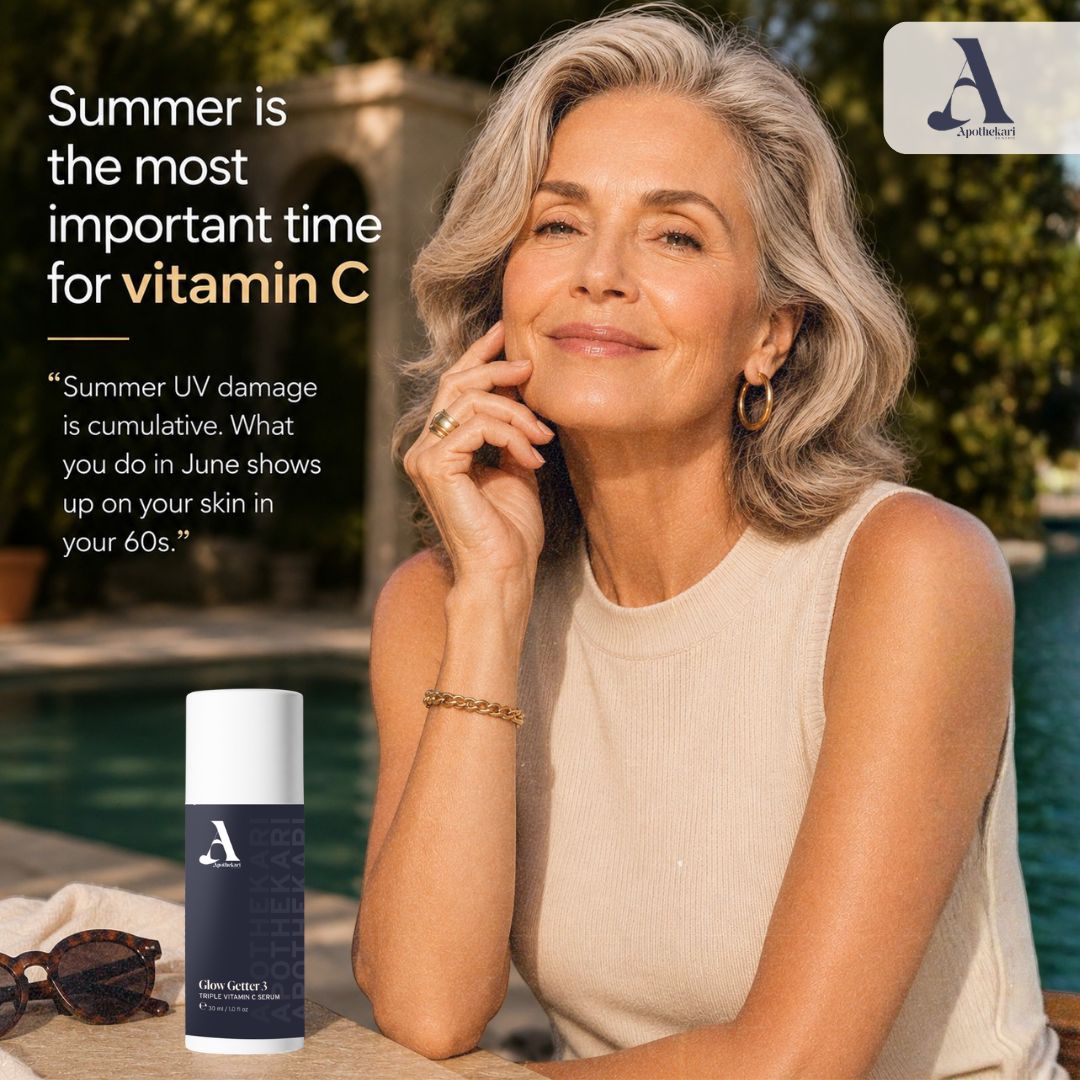
Why Summer Is the Most Important Time for Vitamin C
If you save your vitamin C serum for "someday," summer is actually when it's doing the most work.
UV damage is cumulative. The sun exposure you get this June doesn't just fade by August — it builds quietly in your skin.
It often doesn't show up as dark spots, uneven tone, or sagging until years later. A daily vitamin C serum helps your skin defend itself against that damage while it's happening, not after.
What Does Vitamin C Actually Do for Sun-Exposed Skin?
Sunscreen blocks UV rays from the outside.
Vitamin C works from the inside, neutralizing the free radicals that UV exposure generates in the deeper layers of skin — the same free radicals responsible for collagen breakdown, uneven pigmentation, and premature fine lines.
Think of it this way: sunscreen reflects the damage. Vitamin C cleans up what gets through.
This matters more for women in their 40s and beyond, when estrogen decline has already started to slow collagen production and thin the skin's natural barrier.
Skin has less built-in resilience to begin with. So the cumulative effect of an unprotected summer lands harder and shows up sooner — often as the dark spots and crepiness that seem to "appear overnight" but were actually years in the making.
Why Does Cumulative UV Damage Matter So Much?
Most people picture sun damage as a sunburn — a short-term problem that heals.
But the deeper damage doesn't heal the same way. It breaks down collagen, triggers excess pigment production, and accumulates with every exposure.
The skin's ability to repair itself also gets slower with age. That's why the choices made in summer — sunscreen, antioxidants, sun avoidance during peak hours — tend to show up on skin years down the line, for better or worse.
What Actually Helps Protect Skin During Summer?
A simple, consistent routine does more than a complicated one used inconsistently:
-
Apply vitamin C serum every morning, before sunscreen and moisturizer, so it can get to work neutralizing free radicals throughout the day.
- Choose a multi-form vitamin C rather than a single-form one. Different forms absorb at different rates and depths in the skin, so a blend offers broader protection. Our Glow Getter 3 serum combines L-ascorbic acid, MAP, and tetrahexyldecyl ascorbate for exactly this reason.
- Layer sunscreen on top, reapplying every two hours if you're outdoors or sweating.
- Avoid direct sun between 12pm and 4pm, when UV rays are strongest. Wear hats or sunglasses for extra coverage.
- Support your skin from within with antioxidant-rich foods like berries and leafy greens, which help the skin's own defences against oxidative stress.
Can You Use Vitamin C With Other Active Ingredients?
Yes. Vitamin C pairs well with hydrating ingredients and can be layered with niacinamide or SPF without issue.
The main thing to avoid is applying it at the exact same time as a strong exfoliating acid, since both can be more likely to cause irritation together.
If your routine includes an evening retinal serum, simply keep vitamin C as your morning step and retinal for night. They don't need to compete for the same time slot.
FAQ
Does vitamin C serum replace sunscreen?
No. Vitamin C works alongside sunscreen, not instead of it. Sunscreen blocks UV rays before they reach the skin, while vitamin C neutralizes the free radical damage caused by whatever UV does get through. Both steps are needed for full protection.
Why does sun damage show up years later instead of right away?
UV exposure causes damage to collagen and pigment-producing cells that builds up gradually rather than all at once. As skin's natural repair ability slows with age, especially after 40, that accumulated damage becomes visible as dark spots, uneven tone, and loss of firmness.
What's the difference between single-form and triple vitamin C serums?
Single-form vitamin C serums typically use only L-ascorbic acid, which absorbs quickly but can be less stable. A triple vitamin C formula combines multiple forms that absorb at different rates and depths, offering more consistent antioxidant coverage throughout the day.
Is it too late to start vitamin C if I already have sun damage?
No. Vitamin C continues to help defend against further oxidative damage regardless of your skin's current condition, and consistent use over time can support a more even, brighter-looking tone.
If your skin has taken on a few too many summers without daily antioxidant protection, it's not too late to start.
Meet Glow Getter 3, our Triple Vitamin C Serum — formulated by our founding pharmacist to defend against free radical damage while brightening tone. Clean, fragrance-free, and made for skin that's ready for a simplified routine that actually works.
Curious what else your skin needs this season? Read our guide to building a simplified routine for changing skin or take our 5-Day Skincare Wellness Challenge to find your best next step.


