

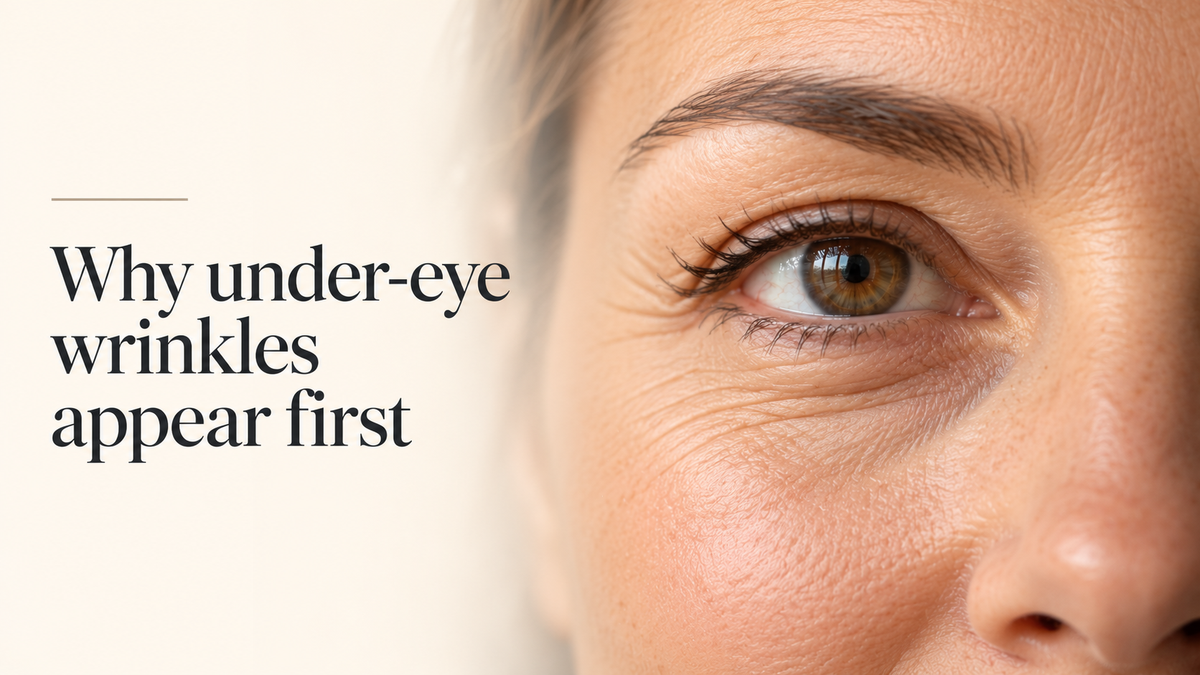
If fine lines around your eyes showed up before anywhere else on your face, that's not bad luck — it's biology.
The short answer is: the skin around the eyes is thinner, has no oil glands, and moves more than almost any other area of the face, which means it shows collagen loss and repetitive-motion lines earlier and more visibly than the rest of your skin.
The Eye Area Is Structurally Different From the Rest of Your Face
Skin thickness varies significantly across the face, and the eye area is the thinnest of all — in some studies, up to 40% thinner than the skin on your cheeks. Thinner skin has less structural collagen to begin with, so any age-related decline in collagen production shows up faster and more visibly here than on thicker-skinned areas.
The eye area also has almost no sebaceous (oil) glands. Oil glands help retain moisture and support the skin barrier elsewhere on the face; without them, the eye area is naturally more prone to dryness, which accentuates the appearance of fine lines.
Constant Movement Adds Up
Unlike most of the face, the eye area is in near-constant motion — squinting in sunlight, smiling, expressing surprise or concern, reading a screen. Every one of these expressions creates a small crease in the skin. Repeated over decades, those creases become the fine radiating lines known as crow's feet.
This is also why crow's feet are considered a dynamic wrinkle in their early stages (visible mainly when you smile or squint) before eventually becoming visible at rest as static lines, once collagen support has declined enough that skin can no longer fully smooth back out between expressions.
Sun Exposure Is Rarely Applied Evenly Here
Sunscreen application around the eyes is inconsistent for most people — either avoided due to stinging, or simply under-applied because it's an awkward area to cover. Since UV exposure is one of the primary drivers of collagen breakdown, this area often accumulates more cumulative sun damage relative to its collagen reserves than the rest of the face.
What Actually Helps the Eye Area
Because this area is thinner and more reactive, it needs a different approach than a standard facial serum — usually a lower concentration of actives, delivered in a way that minimizes irritation.
Encapsulated retinol is often used here instead of standard retinol or retinal, since encapsulation releases the active gradually rather than all at once, reducing the irritation risk on thinner skin.
Peptides support the structural side of the equation, signaling skin cells to maintain collagen production without the exfoliating effect of an acid or retinoid.
Active Eyes combines both — encapsulated retinol and two peptides — specifically formulated for this thinner, oil-gland-free area, rather than a diluted version of a full-face serum.
Sunscreen, applied carefully around the orbital bone, remains one of the most effective preventive steps, even though it's the step most people skip in this exact area.
FAQ
Why do I have crow's feet but no other wrinkles yet? The eye area is thinner, has no oil glands, and moves more than the rest of the face, so it typically shows the effects of collagen decline and repetitive expression earlier than other areas — even when the rest of your skin looks unaffected.
Can I use my regular face serum around my eyes? It's not recommended for actives like retinal or exfoliating acids, since eye-area skin is thinner and more easily irritated. A formula designed specifically for the eye area, at a lower, gentler concentration, is safer for this zone.
Do under-eye creams actually work, or is it mostly marketing? Ingredients matter more than the "eye cream" label itself. Peptides and encapsulated retinol have documented mechanisms for supporting firmness and reducing fine lines specifically in thin, sensitive skin — the formulation and delivery method make the difference.
At what age should I start using an eye serum? There's no fixed age, but since collagen decline and repetitive-motion lines begin well before visible wrinkles appear, many people start a preventive eye routine in their late 20s to early 30s, and a more active, treatment-focused one in their 40s.
Want to understand the ingredient science behind the eye area's actives? Read Peptides 101: What They Actually Do for Aging Skin and meet Active Eyes.


