

Fresh at 8 a.m., Second-Guessing Yourself by 2 p.m.?
You did everything right. You showered, you applied your natural deodorant, and you felt great. Then, somewhere around mid-afternoon, you caught a whiff and wondered: is that me?
If you're a woman over 40, it's not your imagination, and it's not a hygiene problem. The short answer is this: hormonal changes in perimenopause and menopause change how much you sweat and how that sweat smells. Many natural deodorants were built to mask odor with fragrance. They were never designed to control it at the source. That's why the deodorant that worked at 35 can quietly stop working at 45.
The good news? Once you understand what's changed, fixing it is simple.
Why Does Body Odor Change During Menopause?
Sweat on its own doesn't smell. Odor happens when bacteria on your skin break down the proteins and fats in your sweat. Menopause shifts that process in a few ways.
You may sweat more. Hot flashes and night sweats are your body's response to shifting estrogen levels. More sweat means more fuel for odor-causing bacteria.
Your stress sweat is different. Your underarms have apocrine glands, which respond to stress and emotion. Their sweat is richer in proteins and fats than everyday cooling sweat, and bacteria break it down into a stronger smell. Midlife often brings more of it, from career pressure to caring for teens and aging parents at the same time.
Your hormone balance shifts. As estrogen declines, the balance between estrogen and androgens changes. Many women notice their natural scent becomes stronger or simply different from what it used to be.
None of this means something is wrong with you. It means your body has changed, and your deodorant needs to keep up.
Why Do Natural Deodorants Stop Working?
Most natural deodorants rely on one of two approaches. Neither is built for midlife body chemistry.
- Fragrance-first formulas. These smell lovely when you apply them, but they cover odor rather than control it. Once the scent fades, the odor underneath comes through.
- Baking soda formulas. Baking soda can neutralize odor, but it's highly alkaline, while your skin's natural pH is slightly acidic. Many people develop redness, itching or dark patches after weeks of use, and skin often becomes more sensitive with age.
There's also a common misunderstanding to clear up: deodorant is not antiperspirant. Antiperspirants use aluminum to block sweat ducts. Natural deodorants let you sweat normally and work on the odor instead. That's how it should be, as long as the formula actually targets odor.
What Actually Helps With Menopause Body Odor?
The most effective approach works on three fronts: making your skin less welcoming to odor-causing bacteria, neutralizing odor as it forms, and keeping skin comfortable.
That's the thinking behind Apothekari's natural deodorant sprays. Our founder is a pharmacist, and the formula uses a triple odor-fighting system:
- Glycolic acid, an alpha hydroxy acid that gently lowers underarm pH. Odor-causing bacteria prefer a more alkaline environment, so a slightly acidic one makes it harder for them to thrive.
- Saccharomyces ferment, a fermented ingredient that helps neutralize odor and supports a balanced skin environment.
- Ethylhexylglycerin, a skin-conditioning ingredient that helps keep odor-causing bacteria in check.
Just as important is what's not in it: no aluminum, no baking soda, no synthetic fragrance, no parabens, no phthalates and no synthetic colourants. It's never tested on animals.
How Do You Get the Most From a Natural Deodorant After 40?
- Apply to clean, completely dry skin. Moisture dilutes the formula. After a shower, pat dry first.
- Reapply when you need to. A spray makes a midday refresh quick, even on top of what you applied in the morning.
- Keep one in your bag. Hot flashes don't check your schedule. A travel-friendly spray helps you feel confident anywhere.
- Choose breathable fabrics. Cotton, linen and merino let sweat evaporate instead of trapping it against your skin.
- Give it a week. Your skin needs a few days to adjust to a new pH-balancing routine.
FAQ
Why does my body odor smell different during menopause?
During menopause, falling estrogen changes your hormone balance and can trigger more sweating through hot flashes and night sweats. Stress sweat from apocrine glands also contains more proteins and fats, which bacteria break down into stronger-smelling compounds. As a result, many women notice their natural scent becomes stronger or different after 40.
Does natural deodorant work for menopause sweating?
Natural deodorant controls odor, not sweat. It won't stop you from sweating the way an aluminum antiperspirant does, but a well-formulated natural deodorant can still keep you smelling fresh through hot flashes. Look for one that lowers underarm pH and neutralizes odor, rather than one that relies on fragrance alone.
Why does baking soda deodorant irritate my underarms?
Baking soda is strongly alkaline, while healthy skin is slightly acidic. Repeated use can disrupt your skin barrier, causing redness, itching, a rash or darkened patches. Skin often becomes thinner and more sensitive with age, so women over 40 may react even if they didn't before. A baking-soda-free formula avoids this problem.
How often should I reapply natural deodorant during menopause?
Most women do well with one application in the morning and a quick reapplication as needed, such as after a workout or a hot flash. A spray makes this easy because you can apply it around clothing straps and on the go. Always apply to clean, dry skin for the best results.
Find Your Fresh
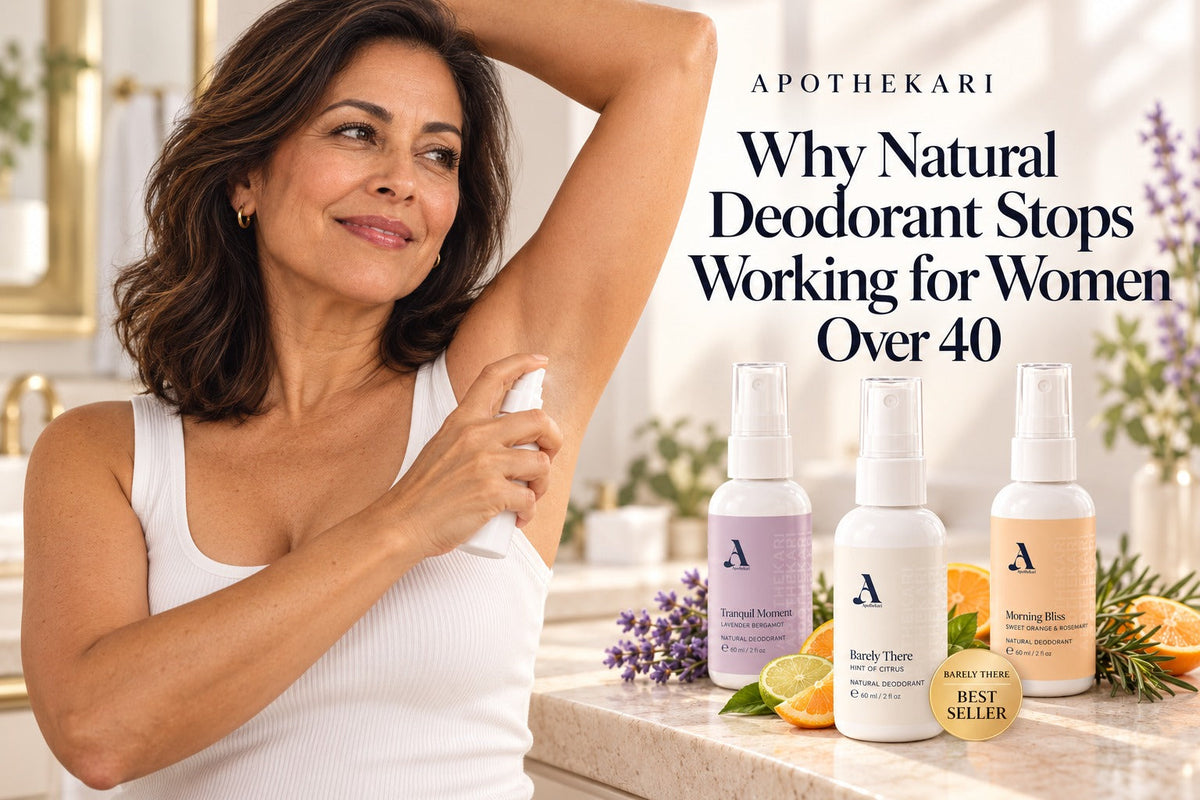
Your body is changing, and that's not something to hide. It's something to work with. If you're ready for a natural deodorant that targets odor instead of covering it, meet the pH Balance Deodorant Set. Try every scent and find the one that feels like you: Barely There with a hint of citrus bergamot, Tranquil Moment with calming lavender, or Morning Bliss with bright sweet orange and rosemary.
Want the science in more depth? Read The Science Behind pH-Balancing Deodorant.


