

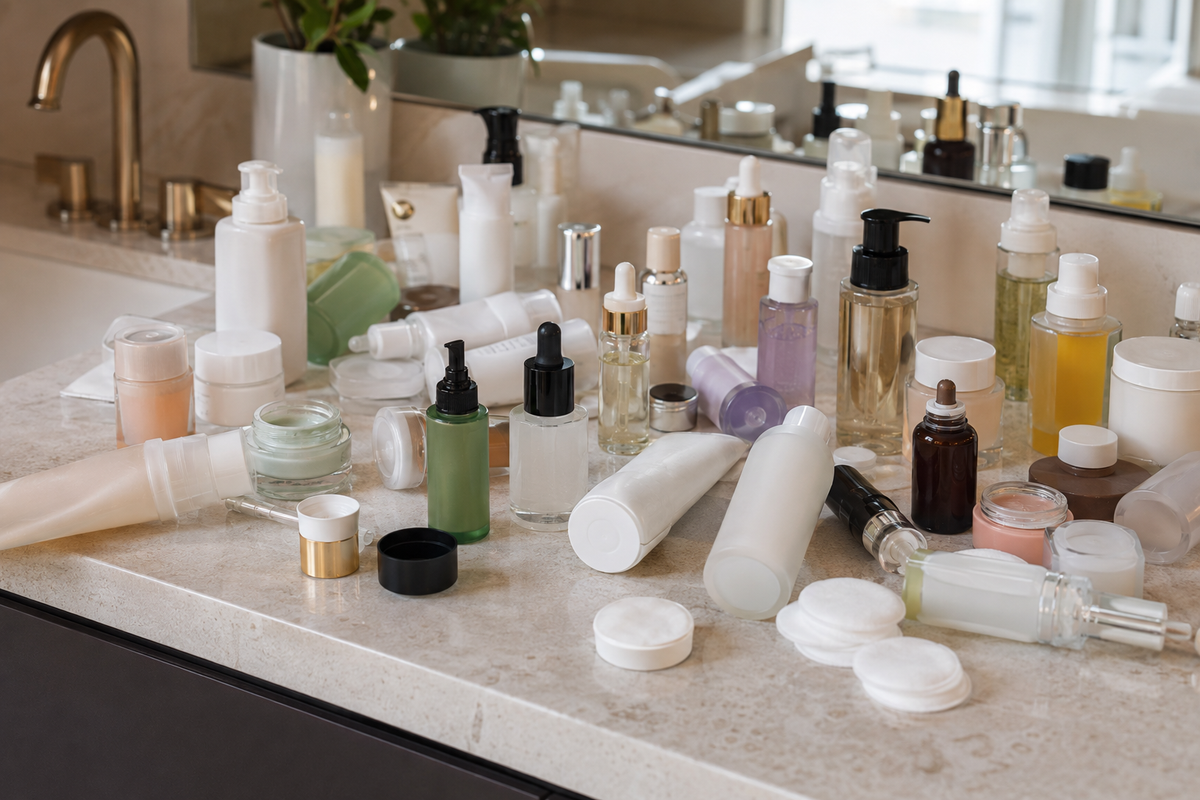
The 10-step routine had its moment, but skincare is moving in the opposite direction.
More brands and dermatologists are pointing to the same idea: a handful of well-chosen products, used consistently, tends to outperform a crowded shelf of ten different ones. This shift toward fewer, better products is often called "skinimalism," and it's less a trend than a return to what actually works.
Why Did the 10-Step Routine Fall Out of Favor?
Layering that many products increases the odds that something in the mix causes irritation, and it becomes nearly impossible to tell which product is responsible when skin reacts.
Each additional step is also another opportunity for actives to compete with, dilute, or destabilize each other, rather than working as intended. For skin that's already more reactive, that adds up to a barrier under constant, low-grade stress rather than one that's being supported.
What Does "Fewer, Better" Actually Mean?
It's not about doing less for your skin — it's about making each step count.
Every product has a clear job. A cleanser, a treatment serum, and a moisturizer each address something specific, rather than five different serums overlapping on the same concern.
Ingredients are concentrated, not diluted. A well-formulated serum can deliver more benefit in one step than three weaker products layered together.
Consistency becomes realistic. A three or four-step routine is one people actually stick with daily, which matters more for results than any single "miracle" product ever will.
Does Simplifying a Routine Mean Giving Up Results?
No — it usually means getting more out of what you use.
Concentrated, well-formulated products don't need to be layered five deep to be effective. A single retinal serum with niacinamide already built in, for example, accomplishes what might otherwise take two separate products applied in sequence.
What Does a "Fewer, Better" Routine Actually Look Like?
A genuinely simplified routine still covers the fundamentals — it just doesn't pile on more than it needs to.
- One cleanser that clears buildup without stripping the barrier.
- One morning serum for antioxidant protection, like a vitamin C.
- One evening serum for renewal, like a retinal.
- One moisturizer to seal it all in.
- Sunscreen, non-negotiable, every morning.
That's the entire routine — five steps, each with a clear purpose, nothing extra competing for attention.
Is a minimalist skincare routine actually better than a longer one?
For most people, yes. Fewer products reduce the risk of irritation, make it easier to identify what's actually causing a reaction, and are simply easier to stick with consistently — which matters more for visible results than product count.
Does simplifying a routine mean sacrificing results?
Not necessarily. Well-formulated, concentrated products can accomplish in one step what a longer routine tries to achieve across several, especially when key ingredients are combined into a single serum.
How many products should a basic skincare routine include?
A cleanser, one morning serum, one evening serum, a moisturizer, and sunscreen cover the fundamentals for most routines — five focused steps rather than a crowded shelf of ten.
Why does simplifying help with consistency?
A shorter routine is easier to complete every single day, including tired nights and rushed mornings, and consistent use of fewer products tends to outperform inconsistent use of many.
If your bathroom shelf has grown longer than your patience for using it every day, simplifying might be the upgrade your skin actually needs.
The Radiant Skin Set pairs one morning serum and one evening serum into a complete two-step routine — built around the idea that fewer, better products win.
Related Reading
- The One Skincare Habit That Matters More Than Any Product
- Here's How to Layer Skin Care Products Right
- Why Does Skin Start to Lose Its Radiance in Your 40s?


