

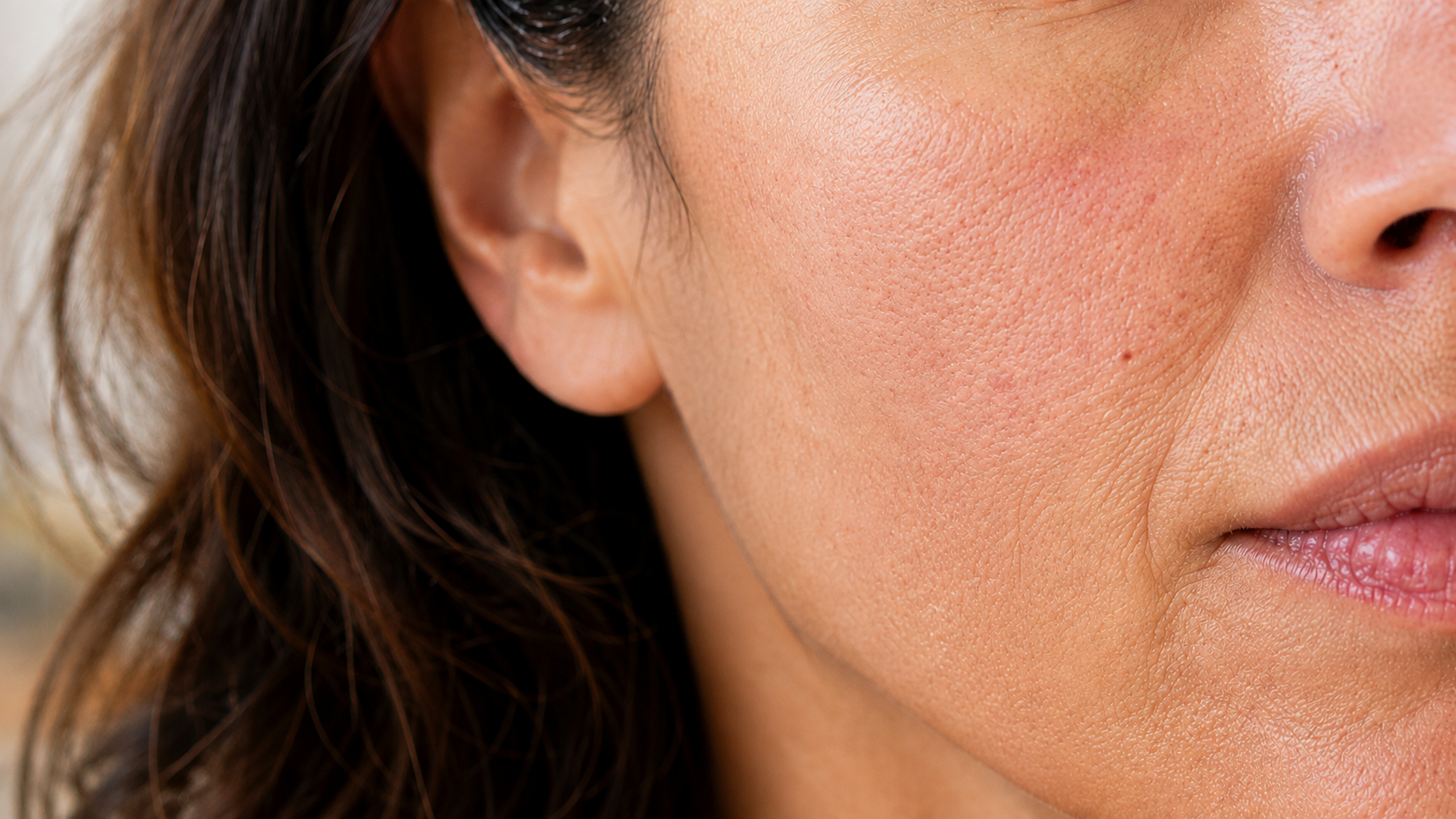
If a product you've used for years is suddenly stinging, or your skin feels tight and reactive no matter what you put on it, your skin barrier is probably the reason. The short answer: declining estrogen slows your skin's ability to produce ceramides and lipids, so it holds onto moisture less effectively and reacts more easily to things it used to tolerate. It's not that your skin got "worse" — it changed, and it needs a different kind of support now.
Why Does This Happen in Your 40s?
Your skin barrier — the outermost layer of skin — is built from skin cells held together by lipids like ceramides, cholesterol, and fatty acids. Think of it as brick and mortar: the cells are the bricks, the lipids are the mortar holding everything in place and keeping water in.
Estrogen plays a direct role in producing those lipids. As estrogen levels begin to decline in your 40s, often years before other perimenopause symptoms show up, lipid production slows down. The mortar gets thinner. Water escapes more easily (what dermatologists call transepidermal water loss), and outside irritants get in more easily too.
This is also why routines that felt totally fine for a decade can start to feel harsh. It's rarely that the product changed — it's that your barrier's capacity to handle it changed. Redness, tightness, occasional stinging with actives you used to tolerate, and skin that looks dull even when you're not "doing anything wrong" are all common signs.
Slower cell turnover compounds this. Dead skin cells take longer to shed, which can make skin look duller and can make it harder for moisturizing ingredients to absorb properly — one more reason products can start to feel like they're "sitting on top" of skin instead of sinking in.
Hormones aren't the only factor. Years of sun exposure and over-exfoliating in your 20s and 30s can leave a barrier already running on thinner reserves, so when estrogen starts to decline on top of that, the effect shows up faster than it would otherwise. Barrier strength is cumulative — built or worn down over decades, not reset each birthday.
Signs Your Skin Barrier Needs Support
A few patterns tend to show up together when the barrier is the underlying issue, rather than an isolated dry patch or one irritating product:
- Stinging or tingling with products that never used to bother you
- A tight, "shrink-wrapped" feeling shortly after cleansing, even with a gentle formula
- Redness or blotchiness that comes and goes without an obvious trigger
- Skin that looks dull or uneven despite a consistent routine
- Breakouts and dryness happening in the same areas at the same time
If two or more of these sound familiar, it's worth shifting your routine's focus from "treating" skin to rebuilding what's underneath it first.
What Actually Helps a Weakened Barrier?
The fix isn't more products — it's the right kind of support, applied consistently. Apothekari was founded by a pharmacist specifically to formulate around this kind of change, so every recommendation below is chosen for a mechanism, not a trend. A few things matter most:
Rebuild the lipid layer. Look for ingredients that mimic what your skin is producing less of. Our Daily Infusion Moisturizer is formulated to hydrate, plump, and support barrier function directly, rather than just sitting on the surface.
Add back lipids through oils. A well-formulated face oil can help replace the fatty acids your skin isn't making as efficiently anymore. Marula Face Oil is soothing and antioxidant-rich, and works well layered under moisturizer on drier days.
Slow down, don't speed up. If your skin is reactive, this isn't the moment to add more actives or exfoliate more often. Simplify first, let the barrier stabilize, then reintroduce actives gradually.
Give it time. Barrier repair isn't instant. Most people notice meaningful improvement in hydration and comfort within four to six weeks of consistent, barrier-supportive care.
Frequently Asked Questions
Why does my skin feel more sensitive now, when it never used to be? Skin sensitivity after 40 is usually barrier-related, not a sudden new "skin type." As estrogen declines, skin produces fewer of the lipids that keep it strong and hydrated, so it becomes more reactive to products, weather, and friction it previously tolerated without issue.
Can a damaged or weakened skin barrier actually be repaired? Yes. A weakened barrier responds well to consistent, simplified care — barrier-supportive moisturizers, gentle cleansing, and fewer harsh actives. Most people see noticeably calmer, more hydrated skin within four to six weeks of a barrier-focused routine.
How do I know if it's my skin barrier and not just dryness? Barrier issues usually come with more than dryness alone — think stinging with products you used to tolerate, redness, a tight feeling shortly after cleansing, or skin that looks dull despite a consistent routine. Plain dryness typically responds to moisturizer alone; barrier issues need lipid-replenishing ingredients and time.
Does everyone's skin barrier weaken at the same rate in their 40s? No. Hormonal decline affects everyone, but the visible impact also depends on prior sun exposure and past over-exfoliation. Two women the same age can have noticeably different barrier strength, which is why a one-size-fits-all routine rarely works as well in your 40s as it did in your 20s.
If your routine has started feeling less reliable than it used to, the fix usually isn't a new serum — it's giving your barrier what it's no longer making on its own. Start by simplifying: a gentle cleanse, a barrier-supportive moisturizer, and consistency for four to six weeks before judging results. Daily Infusion Moisturizer was formulated with exactly this in mind.
Related reading:
- Do You Need a Moisturizer? Maybe Not — a closer look at how estrogen decline changes skin sensitivity after 40
- The One Skincare Habit That Matters More Than Any Product — why consistency matters even more once your barrier is compromised


