

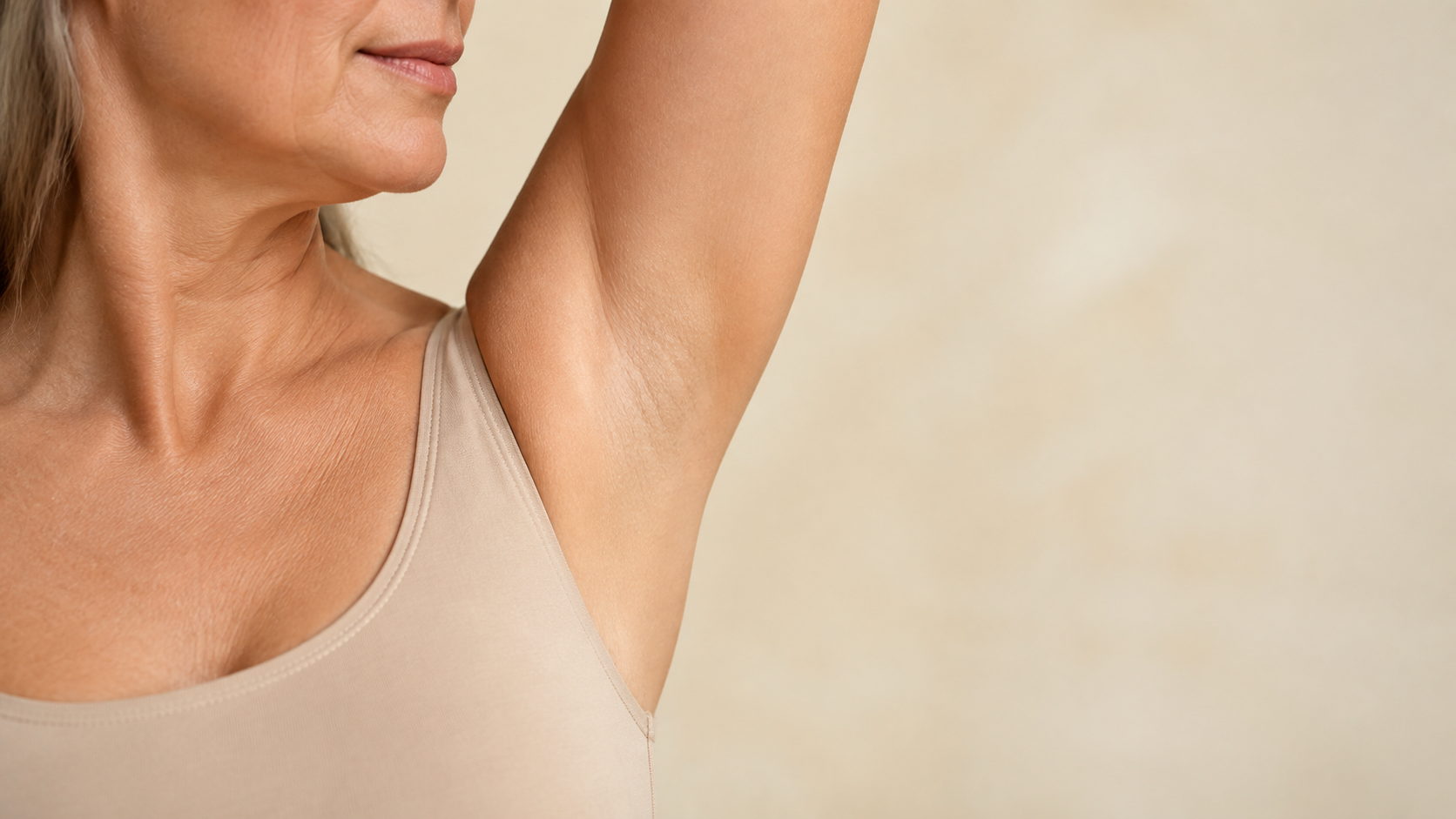
If a deodorant that worked reliably for years suddenly isn't keeping up, that's not a coincidence and it's not a hygiene issue. The short answer: hormonal shifts during perimenopause and menopause change both how much you sweat and how that sweat interacts with skin bacteria, which means body chemistry itself is shifting, not just your deodorant's effectiveness.
Why Does Body Odor Change During Menopause?
Sweat itself doesn't smell. Odor develops when bacteria on the skin break down compounds in sweat, particularly the thicker, protein-and-lipid-rich sweat produced by apocrine glands, concentrated in the underarms and other body-fold areas. Hormonal fluctuation affects this process from multiple directions at once.
Declining and fluctuating estrogen is linked to hot flashes and night sweats, which simply means more sweat production overall, more raw material for odor-causing bacteria to work with. Beyond volume, hormonal shifts also affect skin's pH balance. Underarm skin functions best in a slightly acidic range, roughly 4.5 to 5.5, which keeps odor-causing bacteria in check. When that balance shifts, even modestly, it can create more favorable conditions for the bacteria responsible for stronger odor.
Stress, which often increases during perimenopause alongside sleep disruption and other symptoms, adds another layer: stress sweat is chemically different from regular sweat and tends to produce a stronger odor when broken down by bacteria.
None of this reflects anything going "wrong" with your body. It reflects a genuine shift in body chemistry that your usual products may not be formulated to keep up with.
It's a shift that tends to arrive gradually rather than overnight, which is part of why it's easy to miss at first. Most people notice it as a vague sense that a once-reliable deodorant "just doesn't work like it used to," rather than a dramatic, sudden change, and that gradual onset is exactly why it's easy to blame the product before recognizing the underlying hormonal shift.
What Actually Helps During This Transition?
Look for pH-balanced formulas specifically. A deodorant formulated to support skin's natural pH, rather than one relying heavily on alkaline ingredients like baking soda, works with this hormonal shift rather than against it. Alkaline formulas can actually push underarm pH further out of range, compounding the problem.
Don't assume it's your deodorant's fault entirely. If a natural deodorant that used to last all day now needs reapplication by early afternoon, that's frequently a sign of increased sweat volume and shifting body chemistry, not necessarily an ineffective product. Reapplying once, mid-day, is a reasonable adjustment rather than a sign to abandon natural deodorant altogether.
Address bacteria, not just moisture. Formulas built around odor-neutralizing enzymes and probiotics work by managing the bacterial side of the equation directly, which matters more during a hormonal transition than simply absorbing wetness.
Be patient with formula changes. If you switch deodorants during this transition, give a new formula one to two weeks before judging it. Skin's bacterial balance takes a little time to adjust to a new product, and initial impressions during that window aren't always representative of long-term performance.
Frequently Asked Questions
Is it normal for body odor to get stronger during perimenopause, even before full menopause? Yes. Hormonal fluctuation, not just the final drop in estrogen at menopause, is often enough to trigger noticeable changes in sweat volume and odor. Many women notice this shift in their late 30s or early 40s, well before other more commonly discussed menopause symptoms appear.
Why does my natural deodorant not last as long as it used to? Increased sweat volume from hot flashes and hormonal fluctuation means more material for odor-causing bacteria to break down over the course of a day. A formula that worked fine at a lower sweat volume may simply need a midday reapplication now, which isn't a sign the product has stopped working.
Should I switch to an antiperspirant instead of a natural deodorant during menopause? That's a personal choice, and both approaches are valid. Some people find alternating between a pH-balanced natural formula on lighter days and a stronger option during heavier sweating, like intense hot flash episodes, works better than relying on one formula for everything.
If your deodorant has stopped keeping up, the fix usually isn't reapplying more, it's choosing a formula built for exactly this transition. pH Balance Deodorant Set is formulated to work with shifting body chemistry rather than against it.
Related reading:
- Why Your Deodorant Causes Irritation and the Clean Swap That Works — on why a formula that irritates skin makes odor control harder, not easier
- Why Does Skin Start to Lose Its Radiance in Your 40s? — the same estrogen decline driving odor changes is behind several other 40+ skin shifts


